“Branca had me shaking – I found myself responding in ways that brought me back to my ego, my feelings were disturbed … I found in myself the willingness to connect the music with evil – with power. I don’t want such a power in my life“
John Cage, 1982
Browsing through my personal archives in late 2024, I came across a folder of articles I had written about music and the visual arts back in the 1980s. None of these have ever been published. Re-reading them some 40+ years later I thought that some of them might be of interest to people today.
The first of these uploads is a feature I wrote about the American avant-garde composer Glenn Branca (1948-2018). Please consider these words were written out of enthusiasm, from a youthful mind, without access to the internet. Each page was handwritten, then retyped on a manual typewriter. So, let’s step back in time…
The Sacred Moment
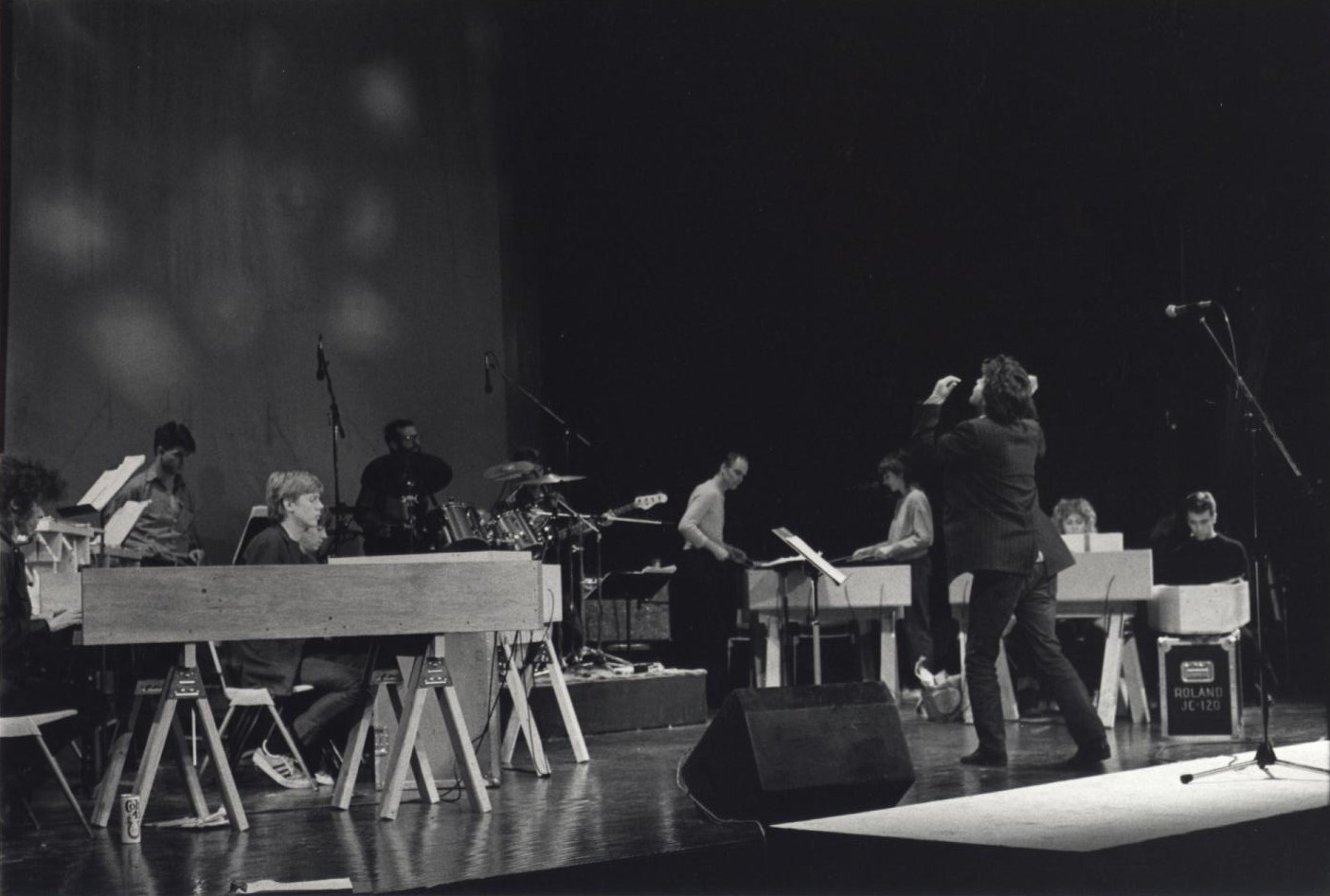
Witness the performance. Across the space stand a dozen musicians each before a breed of instrument born as the offspring of a copulating guitar and harpsichord. The scale is unique. The conductor, Glenn Branca himself, nonchalantly strolls on, dragging his feet. There is silence; no obligatory neo-classical tuning up period, the performance is about to begin. Lifting his arms high in the air, Branca draws out the first chords from his volley of musicians.

The volume begins to grow, increasing in intensity, rhythm is introduced, harmonies are a breach birth, the sound begins to blur, and Branca is contorting his body, broken by the music, sinking lower, unto the grave, until he is pummelling the floorboards with clenched fists. It is a sacred moment – one of possession and obsession. It is one of the most honest and articulate performances I have ever attended.
Branca’s work is rock stripped to the very core of its being. Deafeningly amplified, it can be an explosive force that suggests an absence of horizons or parameters. Branca is able to isolate a riff from the rock vocabulary and deconstruct, thereby extending it and dissolving any obvious associations. With an impetus born out of a rock sensibility, Branca combines the bruitisme of the Futurists and the innovative work of composers such as Varese and Penderecki and weaves it into work of astounding proportions.
The Spiritual and the Sexual
The influence of Harry Patch’s hand-built instruments and an increasing frustration with the limitations of the standard electric guitar led to Branca constructing his own ‘guitar keyboards’ each tuned to a different octave, or part of an octave, and his utilisation of special motorised keyboards and mallet guitars literally struck by a sledgehammer. The volume in itself acts as a tool towards these ends, as a screen that confronts the audience making the space and its acoustics unavoidable.

At its height, it reaches a plateau of sustained intensity that is rarely achieved outside of the spiritual or sexual encounter. Each sound acts on the next. It is a forest fire of sound, of noise, of the extreme, crescendo over crescendo until it becomes a dense, intense continuous field of sound that seesaws between swirling drones that give a feeling of calm serenity and thunderous bolts of ultra – violence that slice away at the tension in your chest.
An Aesthetic of the Acoustic
Using his background in the visual arts (he has had no formal musical training) Branca utilises a palette of protracted crescendos and thundering volume. This is an aesthetic of the acoustic. His Symphony No.3, GLORIA, made use of the complex tones of the harmonic structure of the resonating strings in a manner in which the tuning itself became an aesthetic.
All of the instruments were tuned according to the intervals of the first seven octaves of the harmonic series which in itself contains 128 notes, so in practice it became possible to determine and indeed produce a specific tonal acoustic, reflecting in some respects the work of a refined collage artist like Joseph Cornell or Robert Rauschenberg who act as visual composers for their own work.

Taken further, Branca has exhibited his scores and charts in gallery shows in New York and Cologne, their frenzied markings reminiscent of shattered glass or a spiral staircase. Indeed, it was his score for a piece called ‘Indeterminate Activity of Resultant Masses’ that upset many, John Cage in particular, that had been commissioned by the Brooklyn Academy of Music. As the harmonic series – that is to say, the way in which the acoustic vibrations of notes line up in nature, cannot be written down in the standard manner of a score, Branca had to turn to other methods of realisation.

Unfortunately, for controversies sake, after several failed attempts to represent the piece of music in geometrical form Branca settled on the figure of the swastika. His explanation centred on the spiral development of the work – “I was trying to visualise a 3-dimensional music” – did little to settle the critical response especially after Cage’s slamming of Branca as a musical fascist.
Working with artist Robert Longo
Branca’s work is of an urban mysticism. His relationship with the American artist Robert Longo is more than coincidental. Longo provided the cover art for the first Branca album release taken from his series of line drawings ‘Men in the Cities.’ which in turn was a continuum of the ‘ White Riot Series’. Both artists reflect the violence of the city that they work and reside in, New York City. Both seemingly strive to be monumental.

A swift look at the titles of Branca pieces – The Descension (1980), Bad Smells (1982), Symphony no.2 (The Peak of the Sacred) (1982), and his most recently performed piece, Symphony no.6 (Devil Choirs at the Gates of Heaven) (1988), gives more than a clue to his aspirations. Indeed, the subtitle for his Symphony no.2 is an excerpt from a perplexing quote about materialism by the 19th century German philosopher Ludwig Feuerbach.
Compare these titles with those of Longo – Empire, The Fall, Corporate Wars: Walls of Influence, We Want God. Even his drawings are monumental in scale – over 8 ft in height. And Longo doesn’t just exhibit his art pieces. He played in an art rock band around the time that Branca came to New York in 1976, and recently he used his drawings and paintings as a backdrop to a created environment that used film, music, smoke, and a complex lighting system.
But whereas Longo’s approach was an attempt at mass entertainment, an enormously manipulative attempt at subsuming the participant, the observer in a central space, Branca’s work has the ability to successfully dissolve the boundaries between what is internal and what is external – what is part of the performance, what is part of the score, and how much is inside your head/

Like choral music, Glenn Branca’s work seems to depend upon a kind of communion between audience and performer. Faith needs to be invested in much the same fashion as a religious commitment. It is a language formed to meet demands that Branca makes on itself, but one must learn to understand the unfamiliarity of his terms with PASSION. The seductive and the hysterical are not to be confused.
Read another piece I wrote about Glenn Branca after his death here