Half a century ago in 1967 a record was to appear on the musical landscape that would, over time, prove to demonstrate a profound influence on our sonic landscape. Indeed the composer of this groundbreaking work, American musician Morton Subotnick, described it as ‘chamber music of the future,’ and even today Silver Apples of the Moon presents an uncompromising and extraordinary challenge to modern listeners. Comets of hissing, trilling synthetic sound zig-zag their way across abstract volcanic land, as electronic pulses tumble down upon us, sirens squeal in the distance, and blipping cells spiral into concentric rings of psychedelic bliss.

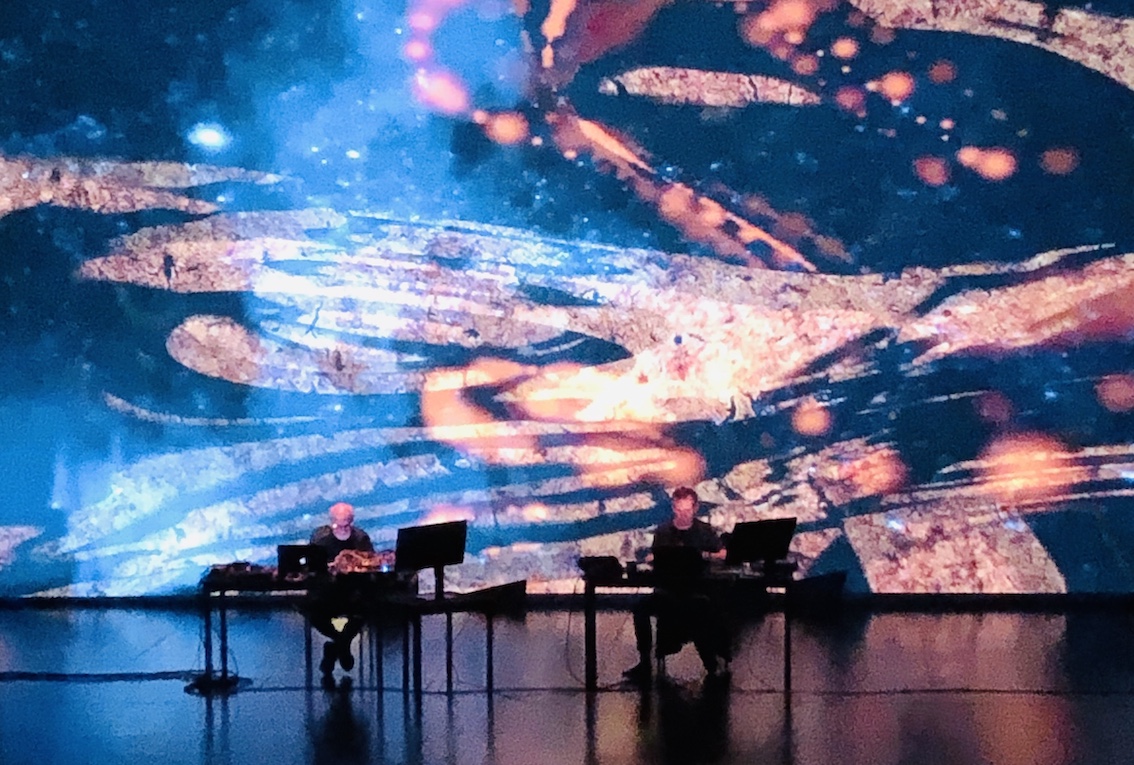
Even today, at 84 years of age, Subotnick is still very much alive and active, energetically travelling the globe performing and presenting his work at festivals and theatres. In celebration of his truly pioneering vision the makers of the acclaimed documentary on modular synthesisers, I Dream of Wires (2014), are focusing on Subotnick for a new official bio-documentary, and production is very much underway. As he finished up preparations towards premiering “Crowds and Power,” a new multi-media tone poem for voice, electronic sound, and live imagery at NYC’s Lincoln Center in July, I was delighted to have a chance to chat with this supremely influential fellow, our conversation peppered with laughter at every turn!
The San Francisco Tape Music Center
I was interested to learn more about the San Francisco Tape Music Center that he established with Ramon Sender back in 1962 in San Francisco, a non-profit cultural organisation, “the aim of which was to present concerts and offer a place to learn about work within the tape music medium.” How did he set up a centre for arts at the time?
“At this point in time we think of it as a public studio, and it became that, but actually we’d been giving concerts at the San Francisco Conservatory and our last concert there sort of made it a stir. The review the next morning said that the concert literally stank, because the dancers were using perfume. My memory was that they didn’t let us back in again! That was it. Pauline (Oliveros) left for Europe and was gone for a year and Roman (Sender) called me and said why don’t we take our stuff and find a studio together. And that’s what we did and we found this house. I tell you this because there’s a sense that we were this public studio set up and this was our studio. I was desperate in the sense that I had decided I wanted to reinvent my life. I was playing clarinet with the symphony and composing and doing all these things, but I realised that what I really wanted to do was find a way to try to find a way to create an electronic music easel, I knew it was going to happen but I wanted to be part of it, but I couldn’t figure out how to do it.

So I enlisted Ramon and we did a lot of research, picking out odds and ends, trying to do something, but it didn’t work, so we decided we could perhaps get some money. So I called this woman who was giving money to the symphony and she said ‘oh sure I’ll send you some money but you have to become non-profit,’ so I said. well I don’t know what quite that is but we’ll do that. We paid $65 dollars to a lawyer friend and we became non-profit and we had to have a name. So the Germans didn’t allow microphones into their studios and the French didn’t allow sine tones into their studio, so we said we’ll call it the Tape Music Center, anything that you put on tape was music. So she sent us a cheque for $25 dollars, which didn’t even pay for the registration! So that’s how we became a centre and a public studio. One thing led to another. We were still looking for money so we started giving concerts and it just kept going and it turned into what it became. So it was never like a studio where others would record, it was just this thing that happened. But at that time there were no private studios, no publicly accessible studios, no venues in that way that were part of an institution. It just grew naturally and it happened. Later we got a bigger place, well that’s a long story, and that place burned down!”

Daily Life at the Center
I was curious to have a picture of how daily life was at the Center then at the time.
“Well, the daily activity was that there was no money!! We survived because of my work with the symphony and Ramon had a stipend. In fact I don’t think Ramon had a job until he was 65!! (much laughter), but we got odd jobs. Once we were asked to transcribe music from a tape recorder because this East Indian architect was improvising at the piano and would record it, but didn’t know to write music and wanted to publish it. At that point Pauline had come back and joined us and we all needed money, so I distributed the job, one third to me, one third to Pauline and one third to Ramon. The funny thing there is that they didn’t have synchronous tape recorders, so Pauline’s pitch got higher because her machine got faster as more tape was pulling through it, so mine started in C Major and hers was in C Sharp! (much laughter). The question was should we do it again, but we decided he would like this and sent it to him and distributed the money. We had odd jobs that people could do that came in. Most of it went back into the studio to keep it going. That was the daily activity.”

The birth of the Buchla Synth
Today the synthesiser is commonplace, where even the lowest grade smartphone offers up a playground of music tools, but back in the early sixties it was still year zero in terms of potential. Before then time was spent cutting and splicing tape together, with figures like Karlheinz Stockhausen and Luc Ferrari championing these tools, but then Robert Moog on the East coast and Don Buchla on the West began developing synthesisers at the very same time, but with very different ambitions. Subotnick had a very direct influence on Buchla too, having commissioned him to breathe life into his idea of ‘an electronic music easel.’
“The first thing I told him was that we didn’t want a keyboard: this was not a new way to do old music. It gives you so much information and I didn’t want that information because I wanted to say to everyone who would look at it that we’ve been doing the same music for over 50,000 years and suddenly we have a different paradigm. It’s like the printing press at that moment, things are going to be different and it’s very hard to do something that hasn’t been done before. So the best you can do is the best you can! And it ain’t gonna be if you have a keyboard in front of you because it will give you all the information, dragging you back in time!”

Reinventing himself
Little was anyone to know that the Buchla was to become a tool that would alter the musical landscape, championed by Suzanne Ciani, Trent Reznor, Aphex Twin and Amon Tobin. His own music and creative approach has sparked entire music genres like techno and electronica, so given his remarkable activity over the years I was curious to know how he felt about the current music scene as he saw it, but it seems, not unsurprisingly, that he’s been far too busy!
“When I made that shift in 1961 I made the decision to re-invent myself and to live with this vision that I had. I’m gradually reaching the point that maybe next year I can retire a little bit and see what everyone else is doing (much more laughter). I’ve been in a hurry to get this thing done and I never thought I’d live this long. Ever since I was a kid I was aware you die. You’d better live the best you can, and I use a quote from Jean Cocteau ‘when I was born death came walking towards me slowly!’”
“I’ve found myself in a world that I didn’t actually know anything about. When I came back onto the stage there were young people with entirely different backgrounds. My stuff just didn’t sound anything like it. At first I thought what am I doing here, this doesn’t make any sense, then gradually I’ve become more comfortable with it. I’ve forced myself into a position where I don’t know what I’m gong to do and that’s really treacherous. If you have an instrument you can just play but as you know this (the Buchla synth) isn’t just an instrument, so you can easily press the wrong button and you’ve got a mess (laughter). It’s exciting and I hate to go out but I love it after it’s over. I’m really addicted to the after glow (laughter)!!”

Thoughts on being a movie star
So clearly with no retirement in sight how does Subnotnick view the film that is currently being made about him?
“It’s been great. It’s a little spooky, well, not when I’m doing it it’s not, but only when I see parts of it and you see yourself up there on screen! Even talking about it makes my stomach a little queasy, but it was exciting. These guys making the film are great though, they disappear. They come and film a whole day and I don’t even know. It’s incredible. I recently I spent a whole day-and-a- half walking through San Francisco with Ramon and the house I used to live in. People came out of the house and said ‘oh we heard that someone lived here and we finally got to meet you”!!
“When I turned 80 we had a party at the private community school in the village and a lot of people came, and everyone got up and did a little tribute, a performance and I thought this was great! I’m at my own memorial service (much laughter)! I mean, all these people were going up saying wonderful things about this person who can’t hear it because you are gone. In a way it’s a little spooky, as it’s like I’m experiencing my life after I’m dead you know. (laughter) but I’m alive and I can see it all. It’s pretty exciting! Fulfilling is the word, it all worked out okay!”
Indeed, it did all work out okay. Off to the bank to “stop the cheques bouncing” as he amusingly put it, Subotnick bids farewell to me, still laughing, The Founding Father of Electronica seemingly oblivious to his musical legacy and innovation, a man sharper and more driven than most people half his age.

ADDENDUM
In 2019 I was invited to perform at the Semibreve Festival in Braga, Portugal and was delighted to discover that amongst all the amazing guests were Morton and his colleague Lillevan, who has provided visuals for Morton over the years. Lillevan and I have been friends for many years already, so it was a joy to greet him again and to finally meet Morton in the flesh.
On our first day there we were driven up to Sanctuary of Bom Jesus do Monte, on the hilltop that looks over the city. As you can see in the photo we had great fun posing before this impressive baroque architecture. Over the following days much laughter was exchanged, from breakfast until dinner.
Turned out that Morton’s hotel room was adjacent to mine. On of the morning of his live show I left my room, closed the door and noticed that Morton’s was wide open. In the corridor one could hear these elastic squiggly sounds as he sat at the desk with his Buchla synth. Turning to me he said “I can never remember how all these damn things work!” and we laughed again.
This article was originally written for Electronic Sound magazine and commissioned to celebrate the 50th anniversary of ‘Silver Apples Of The Moon‘ in 2017